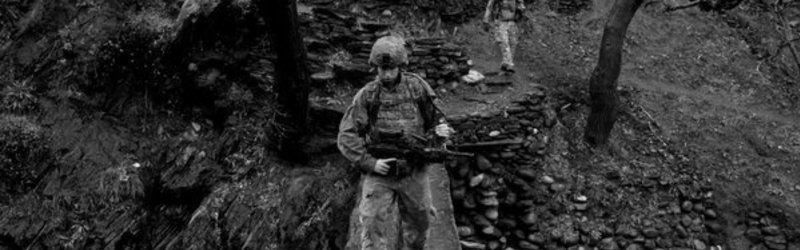
Army Spc. Erik Schei was shot in the head in Iraq. This is the story of his recovery.
Iraq War
The expansion of private-security contractors in Iraq and Afghanistan is well known. But armed security personnel account for only about sixteen per cent of the over-all contracting force. The vast majority—more than sixty per cent of the total in Iraq—aren’t hired guns but hired hands. These workers, primarily from South Asia and Africa, often live in barbed-wire compounds on U.S. bases, eat at meagre chow halls, and host dance parties featuring Nepalese romance ballads and Ugandan church songs. A large number are employed by fly-by-night subcontractors who are financed by the American taxpayer but who often operate outside the law.
A decorated Iraq war veteran with PTSD kills his brother and himself after a high-speed chase near the Grand Canyon.
"I remember lying on my side, dust everywhere, and I looked down and saw my arms were split open and squirting blood and I had just two bloody stumps above my knees," said Marine 1st Lt. James Byler, 26, who was blown up a few weeks before Mark Litynski. "My first coherent words to my Marines were, 'Hey! check my nuts!'
From a small Ohio town to Afghanistan, a portrait of the perpetrator of a massacre.
How the former U.N. weapon’s inspector and “loudest and most credible skeptic of the Bush administration’s contention that Hussein was hiding weapons of mass destruction” ended up embroiled in an Internet sex scandal involving underage girls.
As U.S. troops departed, Baghdad in ruins.
Winner of the 2010 Pulitzer Prize for International Reporting. While on assignment for the New York Times, Anthony Shadid died today in Syria.A reporter makes it his mission to track down all 42 members of a platoon after their service in Iraq.
Specialists Solomon Bangayan and Marc Seiden fought together in Bravo Company’s 3rd Platoon in Iraq. Both were killed.
Here’s how they made it home.
On Thanksgiving weekend, I received a phone call informing me that we had just captured approximately 300 al-Qaeda and Taliban. I asked all our assistant secretaries and regional bureaus to canvass literally the world to begin to look at what options we had as to where a detention facility could be established. We began to eliminate places for different reasons. One day, in one of our meetings, we sat there puzzled as places continued to be eliminated. An individual from the Department of Justice effectively blurted out, What about Guantánamo?
A prescient take on what the US invasion of Iraq would mean for both countries.
The author interviews England in prison:
By now, people all over the world have heard of Lynndie England. She's the "Small-Town Girl Who Became an All-American Monster," as one Australian newspaper headline described her, or "the girl with a leash," as Mick Jagger calls her in the song "Dangerous Beauty." Yet England remains a mystery. Is she a torturer? A pawn? Another victim of the Iraq war? While the world weighed in, England said very little.
An essay on the evolving narrative of martyrdom in the Islamist and secular worlds.
The story of Robert Quinones:
Fifteen months of carnage in Iraq had left the 29-year-old debilitated by post-traumatic stress disorder. But despite his doctor’s urgent recommendation, the Army failed to send him to a Warrior Transition Unit for help. The best the Department of Veterans Affairs could offer was 10-minute therapy sessions — via videoconference. So, early on Labor Day morning last year, after topping off a night of drinking with a handful of sleeping pills, Quinones barged into Fort Stewart’s hospital, forced his way to the third-floor psychiatric ward and held three soldiers hostage, demanding better mental health treatment.
Alan Beaty’s Tennessee farm serves an unofficial halfway house for Marines struggling with their return to civilian life.
The first five years of Iraqi Prime Minister Nouri al-Maliki’s tenure have been marked by a dangerous consolidation of power.
According to political allies and Western diplomats who have worked with Maliki, he isn't so much power-hungry as deeply cynical and mistrusting. The Dawa Party, which Maliki joined as a young man, was hunted by Saddam's Baathist regime. Even those living in exile -- like Maliki, who lived in Syria and Iran for more than 20 years -- organized themselves into isolated cells to protect against the regime's spies and limit the information that any one member might divulge if he were captured or compromised. Maliki's early career was saturated in perpetual suspicion.
In the early years of the Iraq war, the U.S. military developed a technology so secret that soldiers would refuse to acknowledge its existence, and reporters mentioning the gear were promptly escorted out of the country. That equipment—a radio-frequency jammer—was upgraded several times, and eventually robbed the Iraq insurgency of its most potent weapon, the remote-controlled bomb.
What happened when the U.S. Military decided to take its lead from America’s biggest brands.
On the life of an American soldier AWOL in Canada:
I asked him what it's like to have the entire U.S. Army after you, and he thought for a moment and said slowly, "It's like I'm carrying a heavy rock in my backpack." This is as close to introspection as McDowell gets.
On the investors betting big on the Iraqi economy, which they believe has nowhere to go but up.
All told, the military acknowledged this summer, 14 soldiers from the base have been charged or convicted in at least 11 slayings since 2005 — the largest killing spree involving soldiers at a single U.S. military installation in modern history.
Nearly every American soldier injured in Iraq or Afghanistan is treated—for a few days at least—at a single hospital in Landstuhl, Germany.
From the Tower of Babel to the birthplace of Abraham, from Saddam’s ruined palaces to fortified blast-proof checkpoints, a diary from a nine-day, eight-night tour of Mespotamia/Iraq.
A profile of Sabrina Harman, the soldier who took many of the notorious Abu Ghraib photographs.
In January 2009, a U.S. platoon came under rocket attack in Iraq. Two years later, how the event changed the soldiers’ lives.
Published across three consecutive issues of Rolling Stone and later adapted into the book (and miniseries) Generation Kill, the story of ‘Iceman,’ ‘Captain America,’ and their platoon. ”The invaders drive north through the Iraqi desert in a Humvee, eating candy, dipping tobacco and singing songs...”
Omar Mohammed (most certainly not his real name), a former Iraqi cop, is widely believed to be the most skilled and prolific terrorist hunter alive. Recently, he personally killed two of Al-Qaeda’s senior commanders in Iraq. He has already been shot and blown up, and with U.S. forces on their way out, his chances of survival in Baghdad are slim.
The diary of a Scranton, PA National Guardsmen tasked with guarding the highest profile prisoner in U.S history: a surprisingly amiable Saddam Hussein.
How to spend $1.2 million per month on your laundry in Kuwait; the system of kickbacks and non-competitive contracts that made Halliburton/KBR the near-exclusive contractor in the Iraq war zone.
A profile of Valerie Plame and Joe Wilson, published at the height of the controversy.
400,000 Wiki-leaked reports that confirm the minute-by-minute misadventures of a “military at war with its own inner demons” in the unforgiving terrain of Iraq.
The boyish CEO of America’s largest and most controversial mercenary force, Blackwater, also happened to be a C.I.A. agent.
Selections from the leaked documents about the war in Afghanistan portray a military effort that is ineffective and frequently absurd. (Part of the NYT War Logs series.)
The pain and beauty of U.S. military funerals. The author follows fallen soldier Joe Montgomery from field to grave.
The shoot-first-and-ask-questions-later culture of the 101st Airborne Division, an execution of captured Iraqi prisoners, and how far up the chain of command responsibility lies.
A war correspondent decides to rent a house in Baghdad to save money. Complications ensue.
How Christopher Hitchens, a former socialist, became one of the most vigorous defenders of the war in Iraq.
A mission in Baghdad to let a photojournalist get a shot of an insurgent corpse ends up getting a Marine killed.
Kurdistan is the safest and most stable region in Iraq and at the center of its modern history is Amna Surak Prison, ground zero for both a genocide and an uprising.
He was just another coked-up agent (repping the likes of Steven Soderbergh) when he disappeared into Iraq, shooting heaps of footage he would attempt to package into a pro-war documentary. And that was just the beginning.
An acquaintance dies in Iraq and a writer investigates. “How did Michael come to inspire such loyalty? And how did he come to die on the floodplain of the Euphrates? I looked closer and saw they were the same.”
David Petraeus, father of the surge and the uncontested “most competitive” man in the military.