When a 26-year-old Chinese entrepreneur pulled over to answer a text message he was carjacked by Boston bombing suspect Tamerlan Tsarnaev. This is what happened that night and how he escaped.
Terrorism
On the escape of hundreds of insurgents from Kandahar’s Sarposa Prison through a tunnel dug from the outside, and an unlikely suspect: the jail’s former warden.
A clandestine meeting between Western journalists and Hezbollah fighters in a Beirut strip mall.
A profile of the Waffle House terrorists, a group of senior citizens arrested by the Department of Homeland security for plotting a civil war, and the government-hired confidential informant who allegedly led the group astray.
On Thanksgiving weekend, I received a phone call informing me that we had just captured approximately 300 al-Qaeda and Taliban. I asked all our assistant secretaries and regional bureaus to canvass literally the world to begin to look at what options we had as to where a detention facility could be established. We began to eliminate places for different reasons. One day, in one of our meetings, we sat there puzzled as places continued to be eliminated. An individual from the Department of Justice effectively blurted out, What about Guantánamo?
The identity of the designer of a proposed 9/11 memorial competition inflames the emotions and the prejudices of an observer.
"The Rally to Protect Sacred Ground kicked off on a balmy Saturday morning in a plaza opposite the site. The members of both the Memorial Defense Committee and Save America From Islam were there, gathered in a cordoned-off area in front of the stage. Behind them stretched thousands: women holding signs that said NO TOLERANCE FOR THE INTOLERANT or KHAN IS A CON; fathers hoisting small children on their shoulders; men in camouflage who may or may not have been veterans. "
The youngest prisoner held at Guantánamo on his seven years in detention.
A shipping container spewing radiation appears mysteriously at an Italian port, prompting a larger look at the anonymous world of international shipping.
The specter of a biological attack is difficult for almost anyone to imagine. It makes of the most mundane object, death: a doorknob, a handshake, a breath can become poison. Like a nuclear bomb, the biological weapon threatens such a spectacle of horror — skin boiling with smallpox pustules, eyes blackened with anthrax lesions, the rotting bodies of bubonic plagues — that it can seem the province of fantasy or nightmare or, worse, political manipulation.
An interview with the author.
"We live in a frightened time and people self-censor all the time and are afraid of going into some subjects because they are worried about violent reactions. That is one of the great damaging aspects of what has happened in the last 20 years. Someone asked me if I was afraid to write my memoirs. I told him: 'We have to stop drawing up accounts of fear! We live in a society in which people are allowed to tell their story, and that is what I do.' I am a writer. I write books."
Why had the U.S. once again targeted Gaddafi? Of all the evils and perils in the world, there is none that galls Reagan more than terrorism. Of all the anti-American thugs who hang out in the back alleys of the Third World, there is none Reagan despises more than Gaddafi.
As part of his obsessive search for evidence of UFOs, Gary McKinnon worked his way into thousands of government computers. The U.S. charged him with terrorism. Doctors diagnosed him with Asperger’s. And his lawyers started arguing a new version of the insanity defense.
A first-person account of an arrest:
I stared at the yellow walls and listened to a few officers talk about the overtime they were racking up, and I decided that I hated country music. I hated speedboats and shitty beer in coozies and fat bellies and rednecks. I thought about Abu Ghraib and the horror to which those prisoners were exposed. I thought about my dad and his prescience. I was glad he wasn’t alive to know about what was happening to me. I thought about my kids, and what would have happened if they had been there when I got taken away. I contemplated never flying again. I thought about the incredible waste of taxpayer dollars in conducting an operation like this. I wondered what my rights were, if I had any at all. Mostly, I could not believe I was sitting in some jail cell in some cold, undisclosed building surrounded by “the authorities.”
September 11, 2001:
“I felt like I was intruding on a sacrament,” said one firefighter, Maureen McArdle-Schulman. “They were choosing to die and I was watching them and shouldn’t have been, so me and another guy turned away and looked at the wall, and we could still hear them hit.”
An interview with Rudy Giuliani’s fresh-out-of-college head speechwriter, who wrote the eulogies for every policeman and fireman who died on 9/11, giving him “the dark distinction of probably writing more eulogies than anyone else alive.”
A man, a woman, and a child negotiate their uneasy triangle in the days and weeks following 9/11.
"His briefcase sat beside the table like something yanked out of a landfill. He said there was a shirt coming down out of the sky."
On the people who were working at Logan Airport when the hijacked flights departed:
They are the rarely noticed casualties of the terrorist attacks: the security guard, the ticket agent, the baggage handler on the ramp. They made it home that night, but with images they couldn’t shake, a pain uncomfortable to voice. They can’t believe it has been 10 years. They can’t believe it has only been 10 years.
The life history of an unassuming Sudanese man, Noor Uthman Muhammed, who has spent the last nine years in Guantánamo Bay prison.
If the memory of the Twin Towers now belongs to the world, the story of how they have been replaced is entirely of New York: a tale of power, capital, shifting allegiances, and hallowed ground.
On a failed attack in Spokane and the fragments of homegrown terrorism in the United States.
John Walker Lindh’s father on why his son is an innocent victim of the War on Terror.
The story of an imam convicted on a suspect terrorism charge and the place he was sent: a jail in the Midwest where nearly all of the prisoners are Muslims.
David Headley helped plot the Mumbai terror attacks. Now his best friend is on trial for conspiring with him. The prosecution’s key witness: David Headley. The story of an informant trying to save his own life from the witness stand.
With Osama dead, U.S. intelligence is zeroing in on the remaining most dangerous terrorists alive, and one man is at the top of the list. Of the eighteen terror attacks attempted in the United States over the past two years, Anwar al-Awlaki’s fingerprints are on eight of them. The moderate turned radical is eloquent, he is popular— and he’s American.
A profile of Ayman al-Zawahri, the Egyptian doctor who became Bin Laden’s #2 and has now taken over Al-Qaeda.
In June, 1942, a German submarine dropped four young Nazi agents off on a Florida beach. Their mission was to blow up bridges, factories, and Jewish-owned department stores. Among them was Herbert Haupt, the 22-year-old son of a German-American family in Chicago.
A travelogue through the contradiction-rich and predominantly Muslim Southern Thailand.
NYT journalist David Rohde’s alternately terrifying and absurd first person account of his kidnapping en route to an interview in Southern Afghanistan and the subsequent seven months he, along with his translator and driver, spent in captivity in the tribal areas of Pakistan.
Schaeffer Cox, who is accused of plotting to kill State Troopers and a federal judge, shifted rapidly from a Ron Paul campaign worker and Tea Party activist to a hardcore militia leader. His conspiracy revealed, mainstream Alaskan politicians are scrambling to distance themselves from their ties to Cox.
Stuck between the Taliban and the U.S. Military, Afghanistan’s farmers risk their lives both when they grow, and when they refuse to grow, fields of poppies.
After nearly 15 years in a Peruvian prison, an American woman convicted of aiding a Marxist terrorist group finds parole in Lima full of contradictions.
First-person accounts from the 2004 siege of a Russian school in Beslan by Chechen terrorists.
A ragtag band of pirate-Jihadists grab Americans from a diving resort in the Phillipines and lead them on an odyssey through the jungles of an archipelago with the competing interests of the Phillipines’ Navy and Army, the U.S. Military, and the C.I.A. thwarting their rescue.
The apparatus of counterinsurgency and occupation has funneled billions of dollars into Afghanistan, and much of it has ended up in the hands of insurgents. For those who have profited—be it through aid, extortion, corruption or legitimate business—there is very little incentive to bring the conflict to an end.
An investigation into Lashkar-i-Taiba, the group behind the 2008 Mumbai massacre, and why Pakistani authorities has not arrested their leaders.
The epic life story of Rick Rescorla: immigrant, war hero, husband, and head of security at Morgan Stanley/Dean Witter, occupant of 22 floors in the South Tower.
A classified Guantánamo Bay interrogation log reveals the techniques used on Mohammed al-Qahtani, the so-called 20th 9/11 hijacker.
An interview with an ex-CIA agent who is a world expert on the history of car bombing.
A conversation with NYU Law Professor Philip Alston on the legality of ‘targeted killings’ by drones, which have made headlines in Pakistan, but also have been deployed by the C.I.A. in countries like Yemen.
In the wake of 9/11, terrorist networks moved their recruitment and training efforts online, giving birth to Jihad-geeks like Irhabi_007.
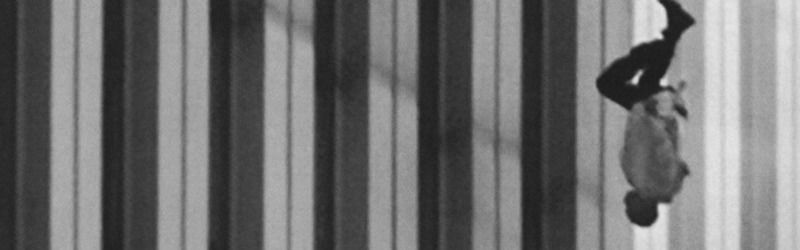
In the days after 9/11, a photo of an unknown man falling from the South Tower appeared in publications across the globe. This is the story of that photograph, and of the search to find the man pictured in it.