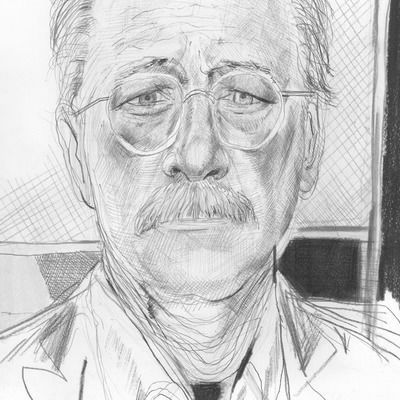
The Storyteller
On the writer W.G. Sebald.
On the writer W.G. Sebald.
The role of money plays a two-sided role in Borges’ artistic life. On one side of the coin’s face, Borges was blessed with the most privileged, ideal life for a burgeoning literary genius. Educated in Europe, raised by his father to become a serious writer, Borges devoted his entire life to literature. He did not take a full-time job for nearly 40 years. But on the coin’s reverse side, we see that young Georgie Borges did not actually write his great fictions until after his family lost their money.
A romance author accused her husband of poisoning her. Was it her wildest fiction yet?
On the unlikely friendship between Nelson Algren and the young writer during the final years of Algren’s life.
It was June of 1980 when Nelson called me breathlessly from the highway.
Franklin Leonard’s anonymous survey has launched careers, recognized four of the past eight Best Picture winners, and pushed movie studios to think beyond sequels and action flicks.
"His friends remembered when Richard became famous. It was the year the hippies came to San Francisco. Richard had published one novel, A Confederate General from Big Sur, but it had sold miserably 743 copies and his publisher, Grove Press, had dropped its option on Trout Fishing in America."
What it was like to report on feminism for Playboy in 1969.
“She has no theories, for example, to explain why she, of all people, felt unburdened by the unspoken rules marking certain subjects off limits for children, or why, for that matter, she has that particular gift, that ability to recall the emotional experiences of adolescence, the confusion, the longing, the rivalries — the memories, in other words, that most of us try to bury as quickly and deeply as we can.”
“Now Pynchon hides in plain sight, on the Upper West Side, with a family and a history of contradictions: a child of the postwar Establishment determined to reject it; a postmodernist master who’s called himself a ‘classicist’; a workaholic stoner; a polymath who revels in dirty puns; a literary outsider who’s married to a literary agent; a scourge of capitalism who sent his son to private school and lives in a $1.7 million prewar classic six.”
On writer James Agee.
On the life of Ray Bradbury.
Didion’s genius is that she understands what it is to be a girl on the cusp of womanhood, in that fragile, fleeting, emotional time that she explored in a way no one else ever has. Didion is, depending on the reader’s point of view, either an extraordinarily introspective or an extraordinarily narcissistic writer. As such, she is very much like her readers themselves.
On Gabo and his complicated role in the country of his birth, Colombia.

