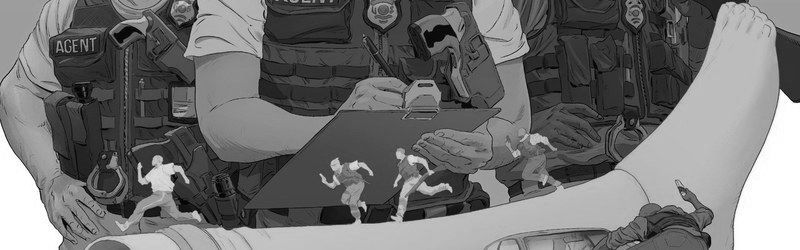
The perilous existence of confidential informants.
Law Enforcement
How Bernardo Provenzano, “boss of all bosses of the Sicilian Mafia” and fugitive for more than 40 years, got caught.
A profile of “not just the toughest but the most corrupt and abusive sheriff in America.”
John MacNeil was convicted by the state of Massachusetts of second-degree murder. He was given a life sentence. He escaped. He was caught. Through an incredible feat of jailhouse lawyering, he somehow got himself paroled and exiled to Canada. Then he came home.
A cop kills a fellow officer during a drug bust and claims it was an accident. Others suspect that it wasn’t.
A fingerprint expert spends decades investigating the death of an unidentified boy found in the woods in 1957.
An investigation of the county’s Tactical Narcotics Team and, in particular, a Christmas-themed sting dubbed “Santa’s Helper”:
A two-month investigation by New Times has found that Santa's Helper was a colossal waste of police resources. Of the 112 suspects arrested, 73 people were charged only with misdemeanor pot possession. The vast majority of the busted pot smokers were either released within 24 hours or avoided jail by promising to show up in court. Of the 73 alleged tokers, 68 of them — including Dante Level and his siblings — had no violent criminal record. If they were guilty of anything, it was smoking a joint on their own front porch.
How did the most wanted man in America, the serial bomber behind the Atlanta Olympics explosion, survive for five years in the North Carolina woods? And was he helped?
How life has changed in the neighborhood where Trayvon Martin was killed.
How the CIA, under a program called MK-ULTRA, used a San Francisco apartment to dose johns with LSD.
The landmark article that changed the way communities were policed:
This wish to "decriminalize" disreputable behavior that "harms no one"- and thus remove the ultimate sanction the police can employ to maintain neighborhood order—is, we think, a mistake. Arresting a single drunk or a single vagrant who has harmed no identifiable person seems unjust, and in a sense it is. But failing to do anything about a score of drunks or a hundred vagrants may destroy an entire community. A particular rule that seems to make sense in the individual case makes no sense when it is made a universal rule and applied to all cases. It makes no sense because it fails to take into account the connection between one broken window left untended and a thousand broken windows.
After being interrogated by the Worcester Police, Nga Truong confessed to smothering her baby.
"If anything happens to me," Ruettimann said, "give this to the reporter." After Ruettimann's death, Hereaux took the file down off his desk. Inside was a thick stack of loose-leaf documents, a manila folder stuffed with letters, and a catalog-size clasp envelope labeled "Reports." Written in black permanent marker in the margin of the envelope was the reporter's name: mine.
Prosecutors have spun creative theories to explain away scientific evidence when DNA tests haven’t fit their version of events.
An investigation into the events surrounding Dominique Strauss-Kahn’s May 2011 arrest for sexual assault.
Ten years ago, a man moved to Marsing, Idaho. He had a strange accent and didn't know much about cattle. The folks in Marsing were a little skeptical at first, but when he built a house and started a family, he earned his neighbors' acceptance. Last February, while buying hay, he was cornered by federal agents and arrested for violent crimes tied to the Boston Mob. And the town wondered: Who the hell is Jay Shaw?
The prison-industrial complex is not only a set of interest groups and institutions. It is also a state of mind. The lure of big money is corrupting the nation's criminal-justice system, replacing notions of public service with a drive for higher profits. The eagerness of elected officials to pass "tough-on-crime" legislation — combined with their unwillingness to disclose the true costs of these laws — has encouraged all sorts of financial improprieties. The inner workings of the prison-industrial complex can be observed in the state of New York, where the prison boom started, transforming the economy of an entire region; in Texas and Tennessee, where private prison companies have thrived; and in California, where the correctional trends of the past two decades have converged and reached extremes.
A tony bedroom community in Los Angeles, a kidnapping gone horribly wrong, and the birth of a teenage fugitive.
On the “Pacification Process,” or how we ended up in the least violent moment in our species’ existence.
Three primary reasons: A desire for vengeance, the sanitization of executions and, ironically, the reliability of DNA evidence.
How a town of 29,000 on the Hudson River came to be “one of the most dangerous four-mile stretches in the northeastern United States.”
A first-person account of an arrest:
I stared at the yellow walls and listened to a few officers talk about the overtime they were racking up, and I decided that I hated country music. I hated speedboats and shitty beer in coozies and fat bellies and rednecks. I thought about Abu Ghraib and the horror to which those prisoners were exposed. I thought about my dad and his prescience. I was glad he wasn’t alive to know about what was happening to me. I thought about my kids, and what would have happened if they had been there when I got taken away. I contemplated never flying again. I thought about the incredible waste of taxpayer dollars in conducting an operation like this. I wondered what my rights were, if I had any at all. Mostly, I could not believe I was sitting in some jail cell in some cold, undisclosed building surrounded by “the authorities.”
After acting erratically and trying to skip out on a dinner bill, she was detained briefly in Malibu before being released in the middle of the night. Twenty-four years old and in an unfamiliar area, she had no car, no phone, and no wallet. A year later, her body was found in a nearby canyon. On the search for answers.
Rogue cops in the LAPD Rampart division’s anti-gang CRASH unit (Community Resources Against Street Hoodlums) were involved in everything from drug smuggling and bank robberies to, allegedly, the murder of Christopher “Notorious BIG” Wallace.
The jury room was a gray-green, institutional rectangle: coat hooks on the wall, two small bathrooms off to one side, a long, scarred table surrounded by wooden armchairs, wastebaskets, and a floor superficially clean, deeply filthy. We entered this room on a Friday at noon, most of us expecting to be gone from it by four or five that same day. We did not see the last of it until a full twelve hours had elapsed, by which time the grimy oppressiveness of the place had become, for me at least, inextricably bound up with psychological defeat.
On the complete corruption of Paul Bergin, a federal attorney turned high-priced defense lawyer now awaiting trial on a host of charges.
If Paul is guilty of half the things they say, he’d be the craziest, most evil lawyer in the history of the State of New Jersey. That is saying something.
In the 1970s, Kelbessa Negewo was a midlevel administrator in Ethiopia’s brutal Red Terror regime. In the 1990s, he was a bellhop in an Atlanta hotel. Then someone he had tortured back home recognized him.
A murder case in Los Angeles, cold since the late ’80s, heats up thanks to breakthroughs in forensic science and leads detectives to “one of the unlikeliest murder suspects in the city’s history.”
The questionable close relationship between a mobster/informant and an F.B.I. agent during a bloody Colombo crime family battle.
When he was 16, Mark Clements talked his way into four life sentences. Twenty-eight years later, he talked his way out.
The anatomy of a bungled, massively expensive undercover sting conducted by the Seattle Police Department.
How slot machines snuck into the mall, along with money laundering, bribery, shootouts, and billions in profits.
For 18 months, Coatesville, Penn., was besieged with an improbable number of arsons. But who started the fires – and why?
On a particularly bloody April weekend in 2008 when 40 people were shot, seven fatally. Not one has faced charges.
The story of dog-scent lineup innovator Keith Pikett and the not-so-scientific science behind forensics.
In 1991, Frank Sterling confessed to a crime he didn’t commit. His story highlights a common – and controversial – method of police interrogation.
The barbaric brutalization of Abner Louima and the tragic fate of a handful of flawed Brooklyn cops.
How a tiny inner core made the Aryan Brotherhood the most feared prison gang in America; coded messages, murders on the outside, and the knowledge that those who are already in for life cannot be punished further.
A young girl is reported missing. The detective assigned to her case quickly discovers she’s been gone for years. The story of his search for justice.
The cop says she nabbed an online sexual predator. He says he was just willing to chat whatever it took to get laid in real life. Their story, from both perspectives.
A profile of Rafael Pérez, an infamously corrupt LAPD officer and the inspiration behind the Vic Mackey character on The Shield.
Dandenis Muñoz Mosquera, a.k.a. “La Quica,” was one of Pablo Escobar’s top killers. Now he’s in a maximum security prison in Colorado. Here’s the thing: for all his crimes, La Quica may not have committed the one that put him away.
For the last two decades, the varied personalities behind the Vidocq Society—retired cops, sketch artists, FBI agents—have gathered in Philadelphia to tackled cold-case homicides over lunch. They claim to have solved more than half.
The cops thought they had captured a fugitive. They had not. Elias Fishburne was a hairdresser from Maryland and was going to jail.
A profile of Edna Buchanan, a Pulitzer Prize-winning crime reporter for the Miami Herald during its heyday.
In an elaborate FBI sting to expose corruption, four agents pose as futures traders in Chicago. The plan works–if you don’t count the hundreds of thousands in taxpayer dollars the agents lost in the process.
The rise and fall of the Seven-Seven - stationed in the war zone of 1980’s Crown Heights, Brooklyn - and how an idealistic young recruit became part of cash-snatching, drug-reselling, renegade clique of cops
A classified Guantánamo Bay interrogation log reveals the techniques used on Mohammed al-Qahtani, the so-called 20th 9/11 hijacker.
The 19-year-old “Barefoot Bandit”—on the run since 2008 and famous for stealing Cessnas without flying lessons, among other feats—was captured this week in the Bahamas. Here, the view of Colt from his hometown.
In 2008, a Brooklyn cop grew gravely concerned about how the public was being served. So he began carrying a digital sound recorder, secretly recording his colleagues and superiors.
This is the story of the night Hannah was not officially raped in Washington, D.C.