Gone
Decades of greed, neglect, corruption, and bad politics led to last year’s Paradise fire, the worst in California history.
Showing 25 articles matching best fc points to buy Buyfc26coins.com is FC 26 coins official site..KzUT.
Decades of greed, neglect, corruption, and bad politics led to last year’s Paradise fire, the worst in California history.

“I always said that when my time came I’d want to go fast. But where’s the fun in that?”

His body wrecked by ALS, the author’s father insisted that his death, like his life, was his to control.

She is venerated around the world. She has outlasted 12 US presidents. She stands for stability and order. But her kingdom is in turmoil, and her subjects are in denial that her reign will ever end. That’s why the palace has a plan.

No house is private. It may be purchased, and thus legally private property, but it doesn’t stand alone. Through its extending wires, pipes, inputs and outputs, the house (with few off-grid exceptions) is tied up in the cyborg systems of the city and the supply chains and logistical inputs that extend around the globe.

The strange saga of Gordon Todd Skinner, a psychedelic aficionado and government informant who is now serving time in prison for kidnapping and torturing his wife’s teenage lover.

How a card-counting former meteorologist from Las Vegas made the first perfect Showcase bid in the 38-year history of The Price Is Right.
Best Article Arts Media Movies & TV
The young Woody Allen writes jokes for supper club comedians, decides he will never make it as a performer and then does, idolizes and is snubbed by Mort Sahl, and develops the comic persona which will make him a star.
The story of three months spent training reporters in Saudi Arabia, where the press is far from free. “I suspected that behind the closed gates of Saudi society there was a social revolution in the making. With some guidance, I thought, these journalists could help inspire change.”

On the shared life of Tatiana and Krista Hogan:
The girls’ doctors believe it is entirely possible that the sensory input that one girl receives could somehow cross that bridge into the brain of the other. One girl drinks, another girl feels it.

Nicola Gobbo defended Melbourne’s most notorious criminals at the height of a gangland war. They didn’t know she had a secret.
Zach Baron is a staff writer for GQ.
“People love to put celebrity stuff or culture stuff lower on the hierarchy than, say, a serial killer story. I think they're all the same story. If you crack the human, you crack the human.”
Thanks to TinyLetter and Squarespace for sponsoring this week’s episode.
John Jeremiah Sullivan is a contributing writer at the New York Times Magazine and has written for Harper's, The New Yorker, and GQ. He is the author of Pulphead and the forthcoming The Prime Minister of Paradise: The True Story of a Lost American History.
“I love making pieces of writing and trying to find the right language to say what I mean. It's such a wonderful way of being alive in the world. I mean, your material is all around you. ... I'm lucky that it has stayed interesting for me. It hasn't faded. The challenges of writing, they still glow.”
Sixteen-year-old Kalief Browder was accused of taking a backpack. He spent the next three years on Rikers Island, without trial.
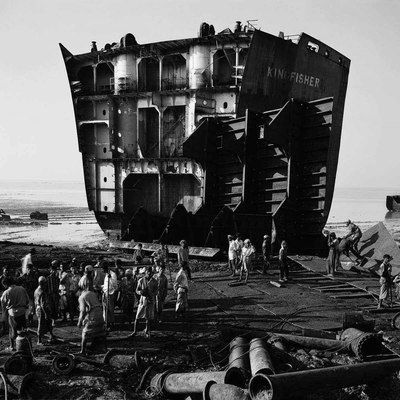
On a desolate, six-mile stretch of Indian beachfront, the bulk of the world’s big ships are dismantled for scrap. Though a ship is usually worth over $1 million in steel, the margins are low, the leftovers are toxic, and the labor—which employs huge numbers of India’s poor—is wildly dangerous.
Allison P. Davis is a staff writer at The Cut and New York.
“I have no real advice other than don’t fuck it up and be afraid all the time. That’s the key to success. Don’t fuck it up. Be a little bit anxious all the time.”
Thanks to MailChimp, Skagen, Aspen Ideas To Go, and Pitt Writers for sponsoring this week's episode.

Best Article Science Tech World
On the development of South Korea’s New Songdo and Cisco’s plans to build smart cities which will “offer cities as a service, bundling urban necessities – water, power, traffic, telephony – into a single, Internet-enabled utility, taking a little extra off the top of every resident’s bill.” The demand for such cities is enormous:
China doesn't need cool, green, smart cities. It needs cities, period -- 500 New Songdos at the very least. One hundred of those will each house a million or more transplanted peasants. In fact, while humanity has been building cities for 9,000 years, that was apparently just a warm-up for the next 40. As of now, we're officially an urban species. More than half of us -- 3.3 billion people -- live in a city. Our numbers are projected to nearly double by 2050, adding roughly a New Songdo a day; the United Nations predicts the vast majority will flood smaller cities in Africa and Asia.

An oddball team of ship salvagers is tasked with uprighting a tipped two-football-field-long cargo ship before it sinks into the darkness of Alaska’s Aleutian Islands.

A Barclays analyst leaves for a routine laser treatment and is never heard from again. Ten months later, authorities find her body under a concrete slab at the house of her doctor, who was in fact not a doctor at all.

Sexual harassment. Hate speech. Employee walkouts. The Silicon Valley giant is trapped in a war against itself. And there’s no end in sight.

Online public spaces are now being slowly taken over by beef-only thinkers, as the global culture wars evolve into a stable, endemic, background societal condition of continuous conflict. As the Great Weirding morphs into the Permaweird, the public internet is turning into the Internet of Beefs.

Against all predictions, the Taliban took the Afghan capital in a matter of hours. This is the story of why and what came after, by a reporter and photographer who witnessed it all.
What it was like to edit The New Republic at its most contentious.
One of the little tweaks I made the first time I got the job was to change the slogan on the table of contents from “A Journal of Politics and the Arts” back to the original: “A Weekly Journal of Opinion.” All the fine reporting notwithstanding, what The New Republic did best, had always done best, was opinion. Its politics were polemical, its art was the art of argument.
Lewis Lapham, formerly the editor of Harper's, is the founder of Lapham's Quarterly.
"The best part of my job was to come across a manuscript. You never knew what would show up. ... I always had the sense of opening a present, hoping to be both delighted and surprised. Often I was disappointed. But when I wasn't, it was a lot of fun. And word got around that I was that kind of an editor, that I was willing to try anything if you could make it interesting."
Thanks to TinyLetter and GoDaddy for sponsoring this week's episode.
Madrid, 1937:
Then for a moment it stops. An old woman, with a shawl over her shoulders, holding a terrified thin little boy by the hand, runs out into the square. You know what she is thinking: she is thinking she must get the child home, you are always safer in your own place, with the things you know. Somehow you do not believe you can get killed when you are sitting in your own parlor, you never think that. She is in the middle of the square when the next one comes.