Showing 25 articles matching 高仿gucci皮带价格网站【A货微信10086082】批发购买出售定制高仿精仿,一比一A货,复刻顶级原单《微信10086082》价格最优手表,包包,皮带,饰品,衣服,鞋子】tz.

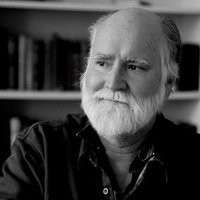
Chris Heath, winner of the 2013 National Magazine Award for Reporting, is a staff writer at GQ.

"I present myself as someone who is going to be rigorous and honest. And if you can engage in the way I'm asking you to engage, then I hope that you will recognize yourself in a more truthful way in this story than you usually do. And maybe even, with a bit of luck, more than you ever have before. That's what I bring. That's my offer."

Thanks to TinyLetter and the The Literary Reportage concentration at NYU's Arthur L. Carter Journalism Institute for sponsoring this week's episode.

</blockquote>
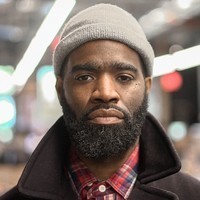
Alzo Slade is a correspondent for VICE News and host of the podcast Cheat.

“Human beings, we are the same, right? Like when you come out of the womb, you need to eat, you need to sleep, you need to pee, you need to shit, and when it comes to emotional needs, you need to feel loved. You need to feel there's compassion, you know? You need to feel significant and of value. And when it comes to like the feeling of significance and feeling valued, I think that's where we start to get into trouble because the same things that you hold of value, I may not in the same way. […] And so if I can engage you and recognize the perspective from which you come, and at least give you an entry level or a human level of respect from the beginning, then the departure point for our engagement is a proper one, as opposed to an antagonistic one.”

Will Mackin is a U.S. Navy veteran who served with a SEAL team in Iraq and Afghanistan. His debut book is Bring Out the Dog.

“I wanted to write nonfiction and I started writing nonfiction. And the reason I did that was — first of all, I felt all the people did all the hard work, and who was I to take liberties? And the second reason was, I just felt an obligation to the men and women who I served with not to misrepresent them, or what they’d been through, or what it had meant to them, or how they felt about it. I kept piling these requirements on to myself: Well, if I present this particular event in this light, this guy’s going to get his feelings hurt. Or, I don’t know how this guy’s family will feel about me talking about this. And it became debilitating, all those restrictions, I kind of kept layering on myself. I was talking to George Saunders at one point about this, and I was like, ‘I don’t know if this book is going to happen. I’m just stuck’ And he pointed out, ‘You’re putting all these restrictions on yourself because it puts this perfect book off in the never-to-reach future. If you remove those and start fictionalizing things and getting at it a different way, maybe it’ll work for you.’”

Thanks to MailChimp and Breach for sponsoring this week's episode.

Eric Lach is a staff writer at The New Yorker, where he covers New York. His latest article is “The Mayor and the Con Man.”

“I think about my own trajectory, my little generation of journalists—it was easier to get jobs reporting on national politics than to get a job reporting on something that you could see and go to and that is a really strange thing, the relief and the joy that I feel like when I can just take the subway twenty minutes to go see something interesting for a story or talk to somebody interesting or explore physically and not just feel like I’m making phone calls and Googling. It’s a very different kind of work, but it’s just not something that was super available.”

Jodi Kantor is a New York Times investigative reporter and the author of The Obamas. On October 5th, she (with Megan Twohey) published an article detailing decades of sexual harassment payoffs by Harvey Weinstein, and she has covered the story extensively since.

“Being a reporter really robs you of self-consciousness and shyness. You realize that it’s this great gift of being able to ask crazy questions, either really personal or very probing or especially with a powerful — to walk up to Harvey Weinstein, essentially and say, ‘What have you been doing to women all these years, and for how long? All of these other people may be afraid to confront you about it, but we are not.’ That is our job.”

Thanks to MailChimp and Eero for sponsoring this week's episode.

Jazmine Hughes is an associate editor at The New York Times Magazine. Her writing has appeared in The New Yorker, Elle, Cosmopolitan, and The New Republic.

“You hope that one day when you’re the editor-in-chief of Blah Blah Blah that you’ll wake up and be like, ‘Okay, I deserve my job.’ But so far I haven’t met anyone who has told me that they feel that way. But, I will say, I don’t talk to white men a lot.”

Thanks to MailChimp, MasterClass, and The Great Courses Plus for sponsoring this week's episode.

Sponsor: Subscribe to The Atavist for 30% Off

Every month, The Atavist publishes a new piece of longform journalism and delivers it directly to the web, your phone, your tablet, and anywhere else you like to read. Subscribers also receive exclusive extras, gift coupons, and access to The Atavist's complete archive of award-winning stories.

Get 30% off when you use the promo code "longform" and subscribe today.</i>

The Man With the $16 House

A profile of Ken Robinson, who earned minor fame and more than a few enemies for the controversial way he “bought” his house:

The week after Robinson moved into the tan-sided home with a faux stone entrance and maroon shutters, he was soaring, an Internet hero a few levels shy of Steven Slater, the JetBlue flight attendant who last summer cracked a beer and left work on a plane's emergency slide. For $16, Robinson had filed paperwork with Denton County staking his claim to the abandoned home through an obscure Texas law called adverse possession. Ever since, curious visitors, beginner real estate investors and people who want an ultra-cheap home to fulfill their version of the American Dream have been knocking on his door for advice and a handshake.

Maria Streshinsky is the executive editor at Wired.

“Sometimes a story comes in and it’s really lovely and well done. And you think if you just got on the phone with this person and pointed out the structure is wrong here and the chronology is wrong here, ask them to change that and send them what is known at Wired as the ‘praise sandwich letter’: how wonderful something is, how much work it will need, how wonderful it will be. … It’s not the kiss of death, it’s ‘we have a lot of work to do.’ … There are lots of pieces that come in that you’ve assigned because it’s the person with the right information with the right access, and they’re a good reporter, but maybe not a terrific wordsmith. So, you do more rewriting. Then there’s the other person that’s a really lovely, lovely writer that doesn’t have the structure and the reporting so you push on that. It’s sort of a three or four-pronged thing—it depends on the piece. I will say, somewhat controversially, there aren’t that many pieces that come in pretty clean.”

Thanks to MailChimp, Skagen, and Pitt Writers for sponsoring this week's episode.

Nicholas Schmidle is a staff writer at The New Yorker.

"I was in a taxi, leaving Karachi to go attend this festival, and we started getting these very disturbing phone calls from newspaper reporters that didn't exist, all of them asking me to meet them at various places in Karachi. I had read enough about the Daniel Pearl case to know what happened in the days leading up, and this was very similar. ... We kept driving towards the festival, and shortly after that, friends started calling. They were watching local television, and it was being reported that 'Nicholas Shamble,' editor of Smithsonian Magazine, had been kidnapped. And I was like, 'All right, I get the hint.'"

Thanks to TinyLetter for sponsoring this week's episode.

</blockquote>

Trust Issues

Hartwick College didn’t really mean to annihilate the U.S. economy. A small liberal-arts school in the Catskills, Hartwick is the kind of sleepy institution that local worthies were in the habit of founding back in the 1790s; it counts a former ambassador to Belize among its more prominent alumni, and placidly reclines in its berth as the number-174-ranked liberal-arts college in the country. But along with charming buildings and a spring-fed lake, the college once possessed a rather more unusual feature: a slumbering giant of compound interest.

The Longform Guide to the Music Business

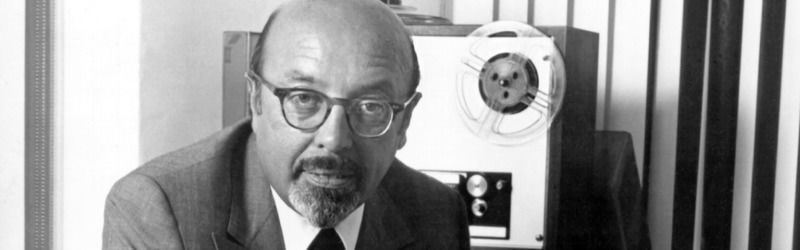
The man who made Bieber, how Nickelback cashes in, and the story of Atlantic Records founder Ahmet Ertegun—a collection of classic articles about the music industry.</p>

Michael Grabell and Bernice Yeung are investigative reporters at ProPublica. They won the George Polk Award for Health Reporting for their coverage of the meatpacking industry's response to the pandemic, including their feature "The Battle for Waterloo."

This is final part of a week-long series of conversations with winners of this year's George Polk Awards in Journalism.

Seth Wickersham is a senior writer for ESPN. His latest article is "For Kraft, Brady and Belichick, Is This the Beginning of the End?"

“You want to write about something real. I hate stories that are, the tension of the story is, talk radio perception versus the reality that I see when I’m with somebody. I can’t stand those stories because to me, you’re just writing about the ether versus a real person, and that’s not a real tension to me. The inner tensions are the best tensions. You can’t get to them with everybody, but you try.”

Thanks to MailChimp and Mubi for sponsoring this week's episode.

Leon Neyfakh is a writer and the host of Slow Burn.

“We didn’t want to be coy about why we were doing the show. We wanted to be up front. We’re interested in this era because it seems like the last time in our nation’s history where things were this wild and the news was this rapid fire and the outcome was this uncertain. That was the main parallel we were thinking about when we started. It was only when we started learning the story and identified the turning points we kept running into these obvious parallels. We mostly didn’t lean into them. We didn’t chase them. There wasn’t a quota of parallels per episode.”

Thanks to MailChimp, MUBI, and Thermacell for sponsoring this week's episode. Also: Longform Podcast t-shirts are now available for a limited time only!

Mona Chalabi is a writer and illustrator whose work has appeared in The New York Times, The New Yorker, and The Guardian, where she is the data editor. Her New York Times Magazine piece “9 Ways to Imagine Jeff Bezos’ Wealth” won this year’s Pulitzer Prize for Illustrated Reporting.

“I kind of think of protest as just saying what you believe. And sometimes, it’s considered protest because it’s outside of the institutions of power. So you’re saying, Hey, Palestinians deserve human rights, and that’s considered a form of protest, right? I want the work to change things and I think I’m quite unapologetic about that, and most journalists are like No no no no no, we’re just reporting the world, we’re just reporting things as we see it. There’s no desire for change. I think that is so messed up. This idea that your work has no impact in the world is incorrect. You can’t wash yourself of the consequences of the work, you have to be considering the consequences while you’re doing it.”

Tessie Castillo, a journalist covering criminal justice reform, and George Wilkerson, a prisoner on death row in North Carolina, are two of the co-authors of Crimson Letters: Voices from Death Row.

“I want other people to see what I see, which is that the men on death row are human beings. They’re incredibly intelligent and insightful and they have so many redemptive qualities...I don’t think I could really convey that as well as if they get their own voice out there. So I wanted this book to be a platform for them and for their voices.” –Tessie Castillo

“For me, writing was like a form of conversation with myself or with my past, like therapy. So I just chose these periods in my life that I didn’t really understand and that were really powerful and impactful to me, and I just sat down and started writing to understand them and make peace with them.” –George Wilkerson

Thanks to Mailchimp for sponsoring this week's episode.

Longform Exclusive: Best of Alternative Journalism eBook Download

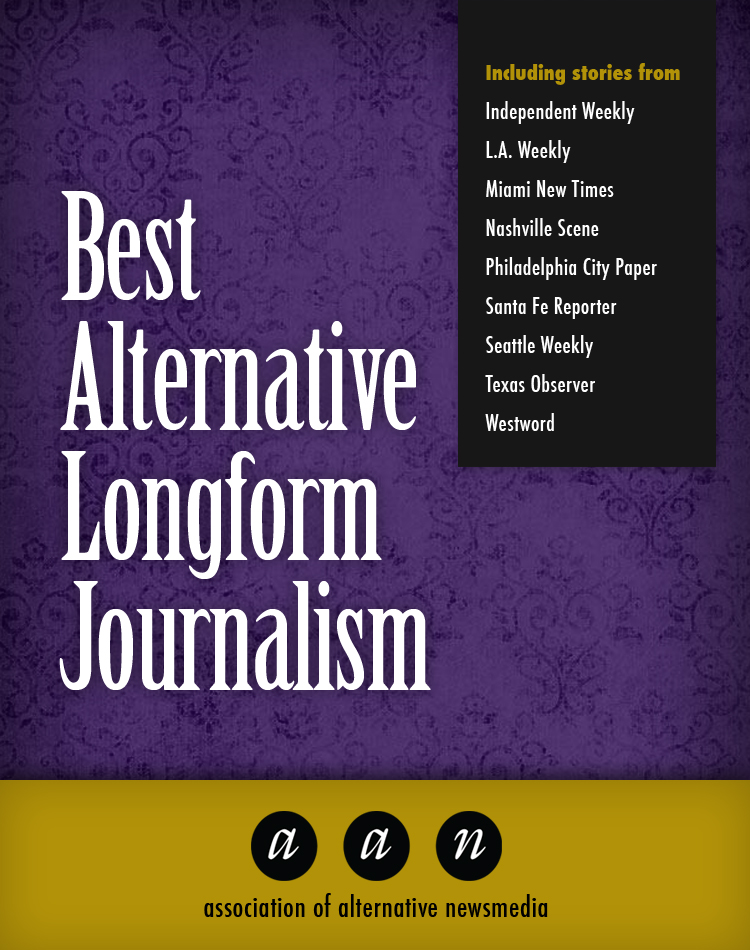
A con man ruining lives from behind bars. A woman who took on her health insurance company and won huge. A producer who lost everything on an epic coke binge. Those stories and more are included in Best Alternative Longform Journalism, a new anthology of great writing from alt-weeklies, which is available free and only through Longform.

Featuring: Gus Garcia-Roberts (Miami New Times), Sharyn Jackson (Santa Fe Reporter), Caleb Hannan (Seattle Weekly), Alan Prendergast (Westword) and many more.

Published by Association of Alternative Newsmedia.

Download Best Alternative Longform Journalism for free:
ePub
mobi (Kindle)
pdf

Send to Readmill

Baynard Woods and Brandon Soderberg are the co-authors of the new book I Got A Monster: The Rise and Fall of America's Most Corrupt Police Squad.

“We really wanted to create some kind of leftist, anti-racist true crime story that we really haven’t seen. The conventions of the thriller often smuggle in all of this really right-wing, pro-police propaganda that all of our cops were raised on—the story of cops having to crash cars and break rules in order to get the bad guys. We wanted to take that and subvert it, using its methods to blow it up from the inside while also being rigorously reported.”

Thanks to Mailchimp and The Jordan Harbinger Show for sponsoring this week's episode.

Nicholson Baker is the author of 18 books of fiction and nonfiction. He has written for The New Yorker, Harper’s, and many other publications. His latest book is Baseless: My Search for Secrets in the Ruins of the Freedom of Information Act.

"In the end, I don’t care how famous you get, how widely read you are during your lifetime. You’re going to be forgotten. And you’re going to have five or six fans in the end. It’s going to be your grandchildren or your great-grandchildren are going to say, Oh, yeah, he was big. … So I think the key is, write what you actually care about. Because in the end, you’re only doing this for yourself. … So maybe do your best stuff for yourself and for the three, four, five people who know in the coming century that you ever existed. That’s all you need to do."

Thanks to Mailchimp for sponsoring this week's episode.

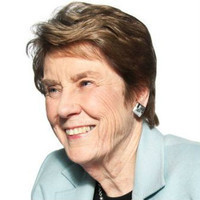
Carol Loomis retired last summer after 60 years at Fortune. She continues to edit Warren Buffett's annual report.

“Writing itself makes you realize where there are holes in things. I’m never sure what I think until I see what I write. And so I believe that, even though you’re an optimist, the analysis part of you kicks in when you sit down to construct a story or a paragraph or a sentence. You think, ‘Oh, that can’t be right.’ And you have to go back, and you have to rethink it all.” 

Thanks to TinyLetter and SquareSpace for sponsoring this week's episode.

Fantasy Island: The Strange Tale of Alleged Fraudster Pearlasia Gamboa

Behind a financial fraud lay a secret plan to create a “mothership for con artists worldwide”:

Gamboa's tale involves secret ore deposits, hidden stocks of Soviet nuclear armaments, the Queen Mary ocean liner, portions of Antarctica, a new version of the Bible, allegations of fake deaths and miraculous resurrections, and a collection of some of the most colorful aliases ever to grace America's criminal and civil case dockets. (According to court documents, Korem also answers to the names Tzemach Ben David Netzer Korem and Branch Vinedresser.)

His Own Private Idaho

Ten years ago, a man moved to Marsing, Idaho. He had a strange accent and didn't know much about cattle. The folks in Marsing were a little skeptical at first, but when he built a house and started a family, he earned his neighbors' acceptance. Last February, while buying hay, he was cornered by federal agents and arrested for violent crimes tied to the Boston Mob. And the town wondered: Who the hell is Jay Shaw?

What Should We Say About David Bowie and Lori Maddox?

“Word choice is hard here. Should we say “raped” automatically if a grown man has sex with a teenager? Does it matter at all if the 15-year-old, now much older, describes their encounter as one of the best nights of her life? What is our word for a ‘yes’ given on a plane that’s almost vertically unequal? Does contemporary morality dictate that we trust a young woman when she says she consented freely, or believe that she couldn’t have, no matter what she says?”