Showing 25 articles matching best fc points to buy Buyfc26coins.com is FC 26 coins official site..KzUT.

Matthew Power is a freelance writer and contributing editor at Harper's.

"The kind of stories I've gotten to do have involved fulfilling my childhood fantasies of having an adventurous life. Even though I don't make a ton of money doing it, I've never felt like I was missing out on something. I haven't worked in an office since a two-week stint as a fact checker at House and Garden magazine in 2001, so that's 12 years, and I haven't starved to death yet."

Thanks to TinyLetter for sponsoring this week's episode!

</blockquote>
Luke Mogelson is a journalist and fiction writer whose work has appeared in The New Yorker, The New York Times Magazine, and other publications. His latest feature is ”Among the Insurrectionists.”

“Get to the front and document as much as you can. ... I think my approach is much more similar to photographers than other writers. I spend a lot of time with photographers and ... I feel like I've gotten pretty good at getting myself into situations where there's few or maybe no other writers around, but there's always a bunch of photographers…. I try to get in right behind the first photographers.”

Thanks to Mailchimp for sponsoring this week's episode.

David Gessner is the author of ten books. His latest is Ultimate Glory: Frisbee, Obsession, and My Wild Youth.

“The ambition got in my way at first. Because I wanted my stuff to be great, and it froze me up. But later on it was really helpful. I’m startled by the way people don’t, you know, admit [they care] … it seems unlikely people wouldn’t want to be immortal.”

Thanks to Casper, Squarespace, and MailChimp for sponsoring this week's episode.

I Bought a Bed

I felt, in some substantive yet elusive way, that I had had a hand in killing my mother. And so the search for a bed became a search for sanctuary, which is to say that the search for a bed became the search for a place; and of course by place I mean space, the sort of approximate, indeterminate space one might refer to when one says to another person, "I need some space"; and the fact that space in this context generally consists of feelings did not prevent me from imagining that the space-considered, against all reason, as a viable location; namely, my bedroom-could be filled, pretty much perfectly, by a luxury queen-size bed draped in gray-and-white-striped, masculine-looking sheets, with maybe a slightly and appropriately feminine ruffled bed skirt stretched about the box spring (all from Bellora in SoHo).

Taffy Brodesser-Akner is a staff writer at the New York Times and the author of Fleishman Is in Trouble: A Novel.

“As a profile writer, the skill I have is getting in the room and staying in the room until someone is like, ‘Why is this bitch still in the room? Get her out of there!’ It’s a journalistic skill that is not a fluffy skill. There are people who are always actively trying to prevent your story, prevent you from seeing it, from seeing the things that would be good to see. There’s a lot of convincing, comforting and listening going on. And there’s a lot of dealing with the fact that somebody in the middle of talking to you can suddenly decide that you are the worst. Those things are very tense and it’s a specific skill that I have that can defray all those things. Or it lets me stay.”

Thanks to MailChimp, Netflix, and Pitt Writers for sponsoring this week's episode.

Sponsor: Fairway Solitaire

Winner of IGN's 2012 People’s Choice Award for Best Mobile Board Game, Fairway Solitaire is an addictive and witty game that combines the classic card game, solitaire, with golf to create a unique experience that's taking over the App Store. (It's rated five out of five stars.)

USA Today said Fairway Solitaire is "so engrossing you can’t simply put it down." Kotaku called it "damn good." And for a limited time, you can get the paid version for free. Download Fairway Solitaire today.

Raquel Willis, the former executive editor of Out, is an activist, journalist, and writer.

Guest host Patrice Peck is a freelance journalist and writes the Coronavirus News for Black Folks newsletter.

“To my peers, I would just say that we have to rethink our idea of leadership. Rethink our idea of storytelling. As the media, we shouldn’t be seeing ourselves as the owners and the gatekeepers of people’s stories. We actually need to be democratizing this experience—sharing the tools of storytelling with other folks. Folks are hungry to tell their own stories and may not always have the tools.”

Thanks to Mailchimp for sponsoring this week's episode.

Style That Works on Your Schedule

Our sponsor this week is Trunk Club, a new way to shop. Trunk Club takes the pain out of finding great men's clothing: instead of having to go the store, you'll get a personal stylist who will find the best clothes to fit your style and budget, then send them right to your door. Keep what you like, give back what you don't free of charge.

There are no hidden fees, no subscriptions, no waiting in line. Just fantastic clothes handpicked for you. Try Trunk Club today.

Christie Aschwanden is a freelance science writer. Her latest book is Good to Go: What the Athlete in All of Us Can Learn from the Strange Science of Recovery.

“I think every writer has this sort of obsession in a story that they write over and over in different forms. For me, it’s about belief and how do we decide what to believe. How do we choose what evidence is credible? How do we make those decisions?”

Thanks to MailChimp and Pitt Writers for sponsoring this week's episode.

Jazmine Hughes is an associate editor at The New York Times Magazine. Her writing has appeared in The New Yorker, Elle, Cosmopolitan, and The New Republic.

“You hope that one day when you’re the editor-in-chief of Blah Blah Blah that you’ll wake up and be like, ‘Okay, I deserve my job.’ But so far I haven’t met anyone who has told me that they feel that way. But, I will say, I don’t talk to white men a lot.”

Thanks to MailChimp, MasterClass, and The Great Courses Plus for sponsoring this week's episode.

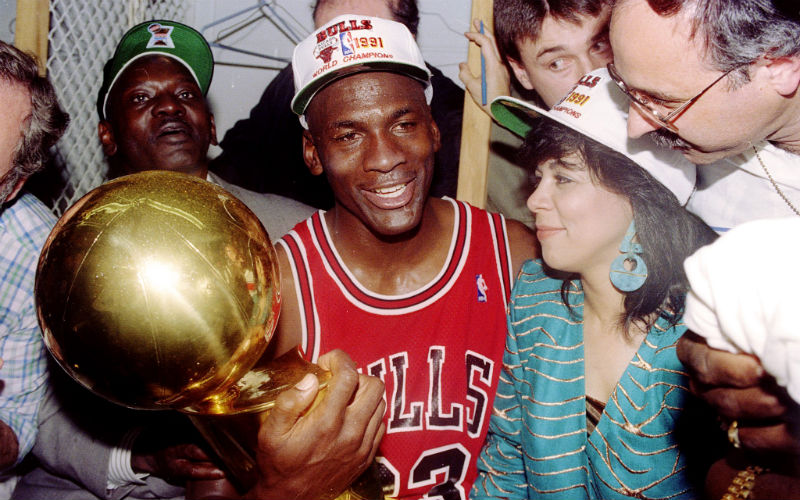
Michael Jordan and the World He Made

The NBA Finals tipoff tonight, with LeBron James gunning for his third straight title. Unquestionably the best player in the world today, James would become one of the best of all-time with another championship.

But he'd still only be halfway to Michael Jordan.

Our latest pick from Open Road Media's archive is the greatest book ever written about the NBA's greatest player: David Halberstam's Playing for Keeps. It tells the story of Jordan's rise, his talent, his unrivaled competitiveness and how the NBA capitalized on his massive appeal.

The book is trademark Halberstam, thorough and fascinating. One of our favorite parts: the chapter on Jordan's first championship, which is available free on Longform.

Download Playing for Keeps between now and June 9 for the special price of $4.99 at Amazon, Apple or Barnes & Noble.

The All-American

In Afghanistan and other zones of international crisis with John Kerry:

Why, then, does Kerry bother? Why is he racing back and forth to put out the fires being set by a serial arsonist? I asked him about this on the short flight from Kabul to Islamabad. Kerry tried to put the best possible face on what he had learned. Despite the warlords in Kabul, he said, Karzai had appointed some talented officials at the provincial and district levels. “It’s a mixed bag,” he concluded gamely. Kerry knew Karzai’s failings as well as anyone, but he was not prepared to abandon Afghanistan’s president, because he was not prepared to abandon Afghanistan. But why not?

Nilay Patel is editor-in-chief of The Verge and hosts the podcast Decoder.

“The instant ability—unmanaged ability—for people to say horrible things to each other because of phones is tearing our culture apart. It just is. And so sometimes, I’m like, Man, I wish our headline had been: ‘iPhone Released. It’s A Mistake.’ … But I think there’s a really important flipside to that … a bunch of teenagers are able to create culture at a scale that has never been possible before. Also, a bunch of marginalized communities are able to speak with coordinated voices and make change very rapidly. And that balance—I don’t think we’ve quite understood.”

Thanks to Mailchimp for sponsoring this week's episode.

Kashmir Hill is a tech reporter for The New York Times. Her new book is Your Face Belongs to Us: A Secretive Startup’s Quest to End Privacy as We Know It.

“I often do feel like what my work is doing is preparing people for the way the world is going to change. With something like facial recognition technology, that's really important because if the world is changing such that every photo of you taken that's uploaded is going to be findable, it's going to change the decisions that you make.”

Adam Higginbotham has written for Businessweek, Wired and The New Yorker. His latest story is A Thousand Pounds of Dynamite, for The Atavist.

"There's always a narrative in a crime story. Something has always gone wrong. These guys are always in prison, because they all fucked something up or trusted the wrong person. They always get caught in the end. Because if they hadn't, you wouldn't be reading about it."

Thanks to TinyLetter for sponsoring this week's episode.

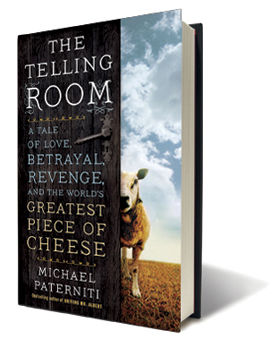
Sponsor: 'The Telling Room' by Michael Paterniti

Our sponsor this week is a fantastic new book from Longform regular Michael Paterniti, The Telling Room: A Tale of Love, Betrayal, Revenge, and the World's Greatest Piece of Cheese. Paterniti spent years visiting a picturesque Spanish village, unearthing a remarkable story of secrets, murder plots, blood fueds and, yes, a very tasty piece of cheese.

George Saunders called The Telling Room "a wild and amazing ride." Susan Orlean said it was "a marvelous tale and a joyful read." We say it's excellent. And it's out today.


Read an Excerpt


Buy the Book:</a></em>
AmazonBarnes & NoblePowell'sKindleiBookstore

Letter from Birmingham Jail

On the moral responsibility to break unjust laws.

Read more

“There comes a time when the cup of endurance runs over, and men are no longer willing to be plunged into the abyss of despair. I hope, sirs, you can understand our legitimate and unavoidable impatience. You express a great deal of anxiety over our willingness to break laws. This is certainly a legitimate concern. Since we so diligently urge people to obey the Supreme Court's decision of 1954 outlawing segregation in the public schools, at first glance it may seem rather paradoxical for us consciously to break laws. One may well ask: "How can you advocate breaking some laws and obeying others?" The answer lies in the fact that there are two types of laws: just and unjust. I would be the first to advocate obeying just laws. One has not only a legal but a moral responsibility to obey just laws. Conversely, one has a moral responsibility to disobey unjust laws. I would agree with St. Augustine that ‘an unjust law is no law at all.’”