Rae Sremmurd’s Best Life
Rae Sremmurd, who held the #1 spot for the last 3 weeks for their song Black Beatles, on the precipice of fame.
Showing 25 articles matching fc points to coins calculator Visit Buyfc26coins.com for latest FC 26 coins news..OtjT.
Rae Sremmurd, who held the #1 spot for the last 3 weeks for their song Black Beatles, on the precipice of fame.
On reservations, where policing hardly exists, bruiser-for-hire vigilantes are often the first choice for justice.
For years, it was the largest portal for sex on the internet. Now its fate could shape the future of Silicon Valley.
Groups protesting lockdown measures see the coronavirus pandemic as a pretext for tyranny—and as an opportunity for spreading rage.
Bonnie Tsui is a journalist and author of the new book Why We Swim.
“I am a self-motivated person. I really don’t like being told what to do. I’ve thought about this many times over the last 16 years that I’ve been a full-time freelancer... even though I thought my dream was to always and forever be living in New York, working in publishing, working at a magazine, being an editor, writing. When I was an editor, I kind of hated it. I just didn’t like being chained to a desk.”
Thanks to Mailchimp and Pitt Writers for sponsoring this week's episode.
Andrea Elliott is an investigative reporter for The New York Times. Her recent book, Invisible Child: Poverty, Survival & Hope in An American City, won a Pulitzer Prize.
”I don’t see reporting as a one-way street. ... I think that people need to know as much as they can about you. And yes, there are boundaries ... but at the same time, the fact of the boundaries is something to talk about with the people you’re writing about. Isn’t it weird that this is my job to be reporting on your life when we can laugh and we can break bread together and I spend all these hours with you and you know about my kids? ... And at the same time, I’m also here to write a book. ... And those two facts I learned to just allow to coexist within me. But it was not easy.”
On nostalgia for Communism.
A requiem for the ‘content portal’ era.
The transgender community fights for health care.
An argument for trying.
Jon Favreau, former chief speechwriter for President Obama, is a columnist at The Ringer and co-host of Keepin’ It 1600.
“And then Obama comes over to my desk with the speech, and he has a few edits. And he’s like, ‘I just want to go through some of these edits and make sure you’re ok with this. I did this for this reason. Are you ok with that?’ And I’m like, ‘Yeah, buddy. You’re Barack Obama.’”
Thanks to MailChimp's Freddie and Co., Freshbooks, Audible, and Squarespace for sponsoring this week's episode.
Adam Grant is an organizational psychologist, author, and host of the podcasts Work Life and Re: Thinking. His new book is Hidden Potential: The Science of Achieving Greater Things.
“If you only focus on your own interest, you tend to develop novel ideas, but not necessarily useful ideas. And so for me, the audience is a filter. … I might have 30 ideas for a book. Let me hone in on the four or five that also might be relevant to other people. The goal there is to make a contribution.”
David Samuels is a contributing editor at Harper's and contributor to The New Yorker and The Atlantic.
"You start by doing the thing you want to do, at whatever level you can. There's this idea that you work your way up by writing captions, and then capsule film reviews or whatever, and I don't think it works that way. I think you learn to master a form, and you start by doing the thing you want to do. At first you're not going to do it as well as you wish you could, and then you learn. At the same time, I think, there's so much dreck, and there's so many people who don't care about doing the thing well, that when that kid walks in your door and they want to do the thing, you say 'Sure,' because it doesn't cost you anything, you look at it, and there's actually some energy on the page, like, yeah, it's bad, but it's bad in a different way. It's bad in the way of someone who might eventually be good."
Thanks to TinyLetter for sponsoring this week's episode!
Emma Carmichael, a former editor at Deadspin and The Hairpin, is the editor in chief of Jezebel.
"Online feminism has more and more rules lately. There are only so many things you can say. And while our opinions are getting more constrained online, personal feminism and face-to-face conversations are looser and more complicated and don't go by any rules. ... The ideal with Jezebel is getting to a point where you can say, 'This is what I think, so who gives a fuck.'"
Thanks to TinyLetter for sponsoring this week's episode.
Evan Ratliff, a co-host of the Longform Podcast, is host of the new podcast Persona: The French Deception.
“One of these big scams is like a story. And in the story, what they're doing is they're manipulating you to be a participant in the story, and they're getting you so hooked that you will not just do anything they say, but you will invest yourself in bringing the story to its conclusion. And like, isn't that what you're doing if you're trying to get someone to listen to eight episodes, spend that much of their life listening to your voice? … The idea that every story has this person pulling the strings... I like revisiting that in everything that I do."
Seymour Hersh is a Pulitzer Prize-winning journalist and the author of The Killing of Osama Bin Laden.
“The government had denied everything we said. We just asked them and they said, ‘Oh no, not true, not true.’ That’s just—it’s all pro forma. You ask them to get their lie and you write their lie. I’m sorry to be so cynical about it, but that’s basically what it comes to.”
Thanks to MailChimp, Johnson & Johnson, Freshbooks, Trunk Club, and Squarespace for sponsoring this week's episode.
Alex Perry, based in England, has covered Africa and Asia for Newsweek and Time. His most recent book is The Rift: A New Africa Breaks Free.
“I got a call from one of my editors in 2003 or 2004, and he said something like, ‘You realize someone has died in the first line of every story you’ve filed for the last eight months?’ And my response was, ‘Of course. Isn’t that how we know it’s important?’ It took me a long time to work out that the importance of a story isn’t established only by death.”
Thanks to MailChimp, </em>Feverborn</a>, and AlarmGrid for sponsoring this week's episode.</p>
Ta-Nehisi Coates is an author and journalist. His next book is The Message.
“I don’t think we have the luxury as journalists of avoiding things because people might say bad things about us. I don’t even think we have the luxury of avoiding things because we might get fired. I don’t think we have the luxury of avoiding them because somebody might cancel some sort of public speech that we have. I then have to ask you, what are you in it for? Like, why did you come here? Did you come here just to make a living? Because there are many other things where you could make more money.”
Lewis Lapham, formerly the editor of Harper's, is the founder of Lapham's Quarterly.
"The best part of my job was to come across a manuscript. You never knew what would show up. ... I always had the sense of opening a present, hoping to be both delighted and surprised. Often I was disappointed. But when I wasn't, it was a lot of fun. And word got around that I was that kind of an editor, that I was willing to try anything if you could make it interesting."
Thanks to TinyLetter and GoDaddy for sponsoring this week's episode.
Lauren Hilgers is a journalist and the author of Patriot Number One: American Dreams in Chinatown.
“You just need to spend a lot of time with people. And it’s awkward. I read something when I was first starting out as a journalist in China, ‘Make a discipline out of being uncomfortable.’ I think that’s very helpful. You’re going to feel uncomfortable a lot of the time, and just decide to be okay with it and just keep going with it.”
Thanks to MailChimp, Substack, and Skillshare for sponsoring this week's episode.
Aaron Lammer is a co-host of the Longform Podcast and the host of the podcast Exit Scam: The Death and Afterlife of Gerald Cotten.
“Something I got from a number of reporters that I’ve interviewed on the Longform Podcast is letting the story guide you, and ultimately that led me to an ambiguous ending. Early on, I was like, the pinnacle achievement is to solve this case. But ultimately, I felt like an ambiguous ending was the most honest to what I actually experienced in reporting it.”
Thanks to Mailchimp for sponsoring this week's episode.
Sponsored
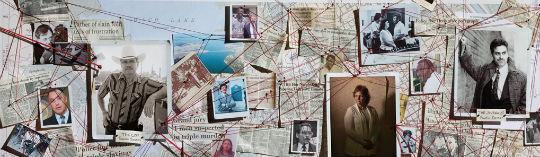
Our sponsor this week is Texas Monthly, which has just published a truly incredible piece of journalism. Michael Hall, whose work has appeared on Longform many times, spent a year investigating one of the most confounding criminal cases in Texas history. In the summer of 1982, three Waco teenagers were savagely murdered for no apparent reason. Four men were ultimately charged with the crime. One was executed, two others were given life sentences, and a fourth was sent to death row only to be released after six years. They all may have been innocent.
Over the next two weeks, Texas Monthly will serialize Hall's 25,000-word piece, "The Murder at the Lake," which looks at the case from five distinct perspectives. Part One is available now; you should read it.
On Jonny Greenwood:
Greenwood is an anomaly: a musician who made his name with a rock band and who is now embraced by the modern-music establishment as an actual, serious composer. The night before the Alvernia session, he was onstage in an aircraft-hangar-size room at a steel plant in Krakow, performing the minimalist composer Steve Reich’s “Electric Counterpoint” for an audience that included Reich himself, as part of a weeklong new-music festival, Sacrum Profanum. (Reich is a fan; he praises Greenwood’s decision to have the string section play with guitar picks on “Popcorn Superhet” as “the first new approach to pizzicato since Bartok.”) He wasn’t the only performer at Sacrum Profanum with pop-music credentials — the bill also included the techno provocateur Aphex Twin and Adrian Utley, from the trip-hop band Portishead. But he was the only guy from a superfamous rock band whose singer has appeared on the cover of Rolling Stone.
Reggie Ugwu is an arts reporter for The New York Times.
“I find that even though I talk to celebrities or popular artists, I’m not all that interested in celebrity. I’m pretty uninterested in celebrity. But I’m really interested in creativity.”
Thanks to Mailchimp for sponsoring this week's episode.
Laurel Braitman is a science writer, the author of Animal Madness: Inside Their Minds, and the founder of Writing Medicine. Her new book is What Looks Like Bravery: An Epic Journey Through Loss to Love.
“My life was becoming unmanageable, in a way. I was using success in many ways like a drug, and I’d say like an analgesic on the sorts of difficult feelings I hadn’t wanted to face truly since childhood. And we are rewarded in this culture for these kinds of outward forms of success that often have nothing to do with what’s going on inside of you.”